
 Image 1 of 1
About the Painting
Provenance:
Spanierman Gallery
Private collection, New York
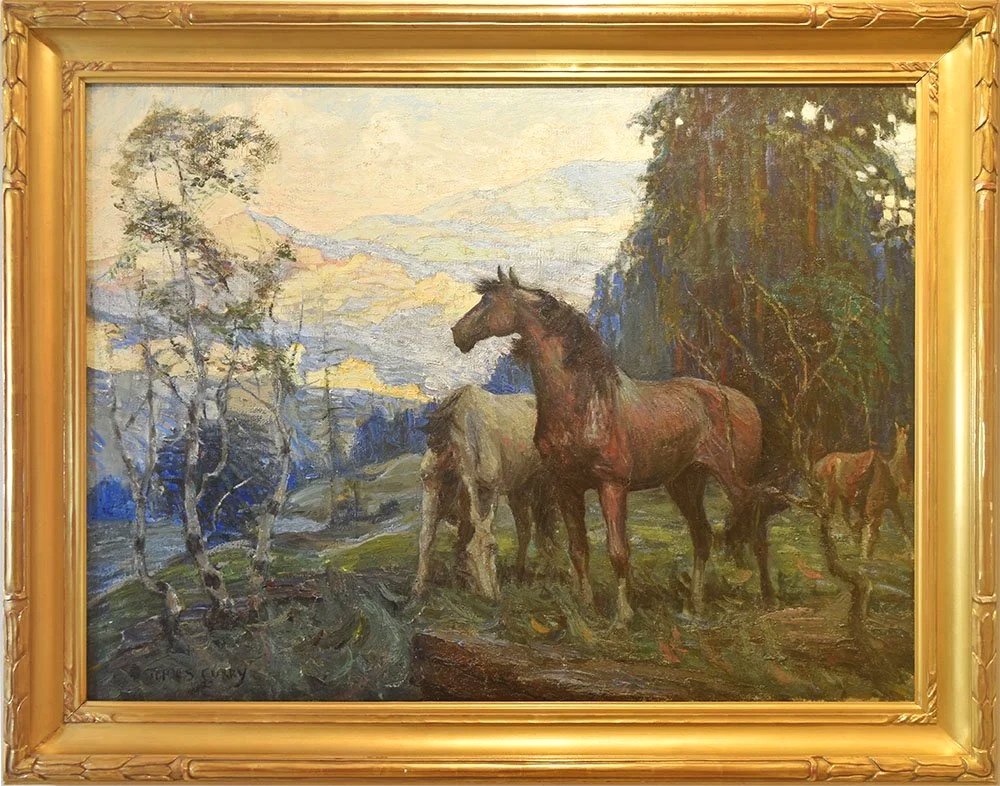
This painting relates to the "My Friend Flicka" works done in 1940.
Curry provided the artwork for the original 1941 publication of My Friend Flicka, written by Mary O'Hara in 1941. The story recounts the experience of the McLaughlin family on their family-owned Goose Bar Ranch in Wyoming, which later became a movie. While not directly used in the book, the painting clearly served to inform some of the illustrations that Curry created.
Curry began drawing horses on his family’s farm as a boy, and the horse appears often in his mature art. In his attempts to render anatomy and movement, he studied not only live horses but also those rendered by the old masters, including Eugène Delacroix, Peter Paul Rubens, and Leonardo da Vinci.
In 1936, Curry was appointed as the first artist-in-residence at the College of Agriculture of the University of Wisconsin, which built him a small studio. He had no classes to teach nor any specific duties; he was free to travel throughout the state and promote art in farming communities by providing personal instruction to students. The painting was produced during this period. As seen later, the experience turned Curry into a conservationist.
Curry continued to work at the University of Wisconsin until he died of a heart attack in Madison in 1946, at the age of 48.
Artist Bio
John Steuart Curry was born in Dunavant, Kansas, and, after training at the Chicago Art Institute, the Kansas City Art Institute and Paris’s Academie Julian, major publications such as the Saturday Evening Post gainfully employed his talent for illustration. While teaching at the Art Student’s League and Cooper Union in New York City, Curry rejected the impersonal quality of industrialism to favor subject matter reflective of his agrarian background.
From 1936 to 1946, Curry served as the first artist-in-residence for the University of Wisconsin’s College of Agriculture. In this role, Curry focused on familiar Wisconsin themes such as the University football team, livestock, and the rural landscape surrounding Madison as a way to connect the students and faculty with the rural community. Curry was commissioned for several mural projects: the Department of the Interior and Department of Justice in Washington, D.C., as well as the Kansas State Capitol in Topeka. Their subject matter reflected Curry’s desire to create art meaningful to the American people. His work is also installed in numerous museums, including the Whitney and Metropolitan Museums in New York.