
 Image 1 of 1
-
Un Gage d’Amour comes at a pivotal point in Buehr’s career, during his time spent in Giverny, France.
In the spring of 1909, Karl Buehr took his family to Giverny, a small agricultural village and artists' colony on the Seine about forty miles northwest of Paris. That he should decide to spend the summer there is not surprising, for during the first decade of the twentieth century, Giverny had emerged as an important gathering place for a number of talented painters who, like Buehr, hailed from the Midwest, among them Frederick Frieseke, Richard Miller and Lawton Parker. Henry Salem Hubbell, who had been sent to Giverny by his (and Buehr's) patron, Lydia C. Ward, was also in Giverny during this period, providing Buehr with further incentive to leave Paris for the Normandy countryside.
Buehr made seasonal visits to Giverny from 1909 to 1911, and he spent the summers of 1912 and 1913 in the nearby village of Saint-Genevieve. His sojourns in Giverny were pleasant and convivial; he and his wife socialized with fellow American artists, while his children were often invited to Le Pressoir, to play with the grandchildren of Claude Monet, Giverny's famous resident artist. It was in Giverny, as well, that Buehr taught printmaking techniques to students attending Mary Wheeler's art school. Most importantly, Giverny proved vital to Buehr's evolution as a painter, for it was there that he abandoned his former concern for landscapes, marines and peasant subjects and adopted the thematic and stylistic concerns of his fellow Midwesterners, who focused their attention on depicting genteel female types relaxing in cozy domestic settings or sunny flower gardens. Inspired by the intimate genre scenes of the Nabis painters Pierre Bonnard and Edouard Vuillard, Frieseke and his cohorts worked in a decorative Impressionist manner, combining brilliant colors, structured designs, and an emphasis on lively patterning with a traditional portrayal of figure indebted to the example of Pierre-Auguste Renoir.
Buehr responded with enthusiasm to this more advanced form of Impressionism and by the summer of 1910 was painting colorful depictions of attractive women—sometimes his wife, the miniature painter Mary Hess Buehr, or models hired from Paris—in both indoor and outdoor settings. He continued to explore the theme of the female figure following his return to Chicago in 1913—to the extent that in the wake of his death decades later, a writer for the Chicago Tribune observed that "the mention of [Buehr's] name spells sunshine on a summer day, clear, lovely women who smile from a fresh canvas, and a quantity of flowers. Storm and shadow were foreign to him."1
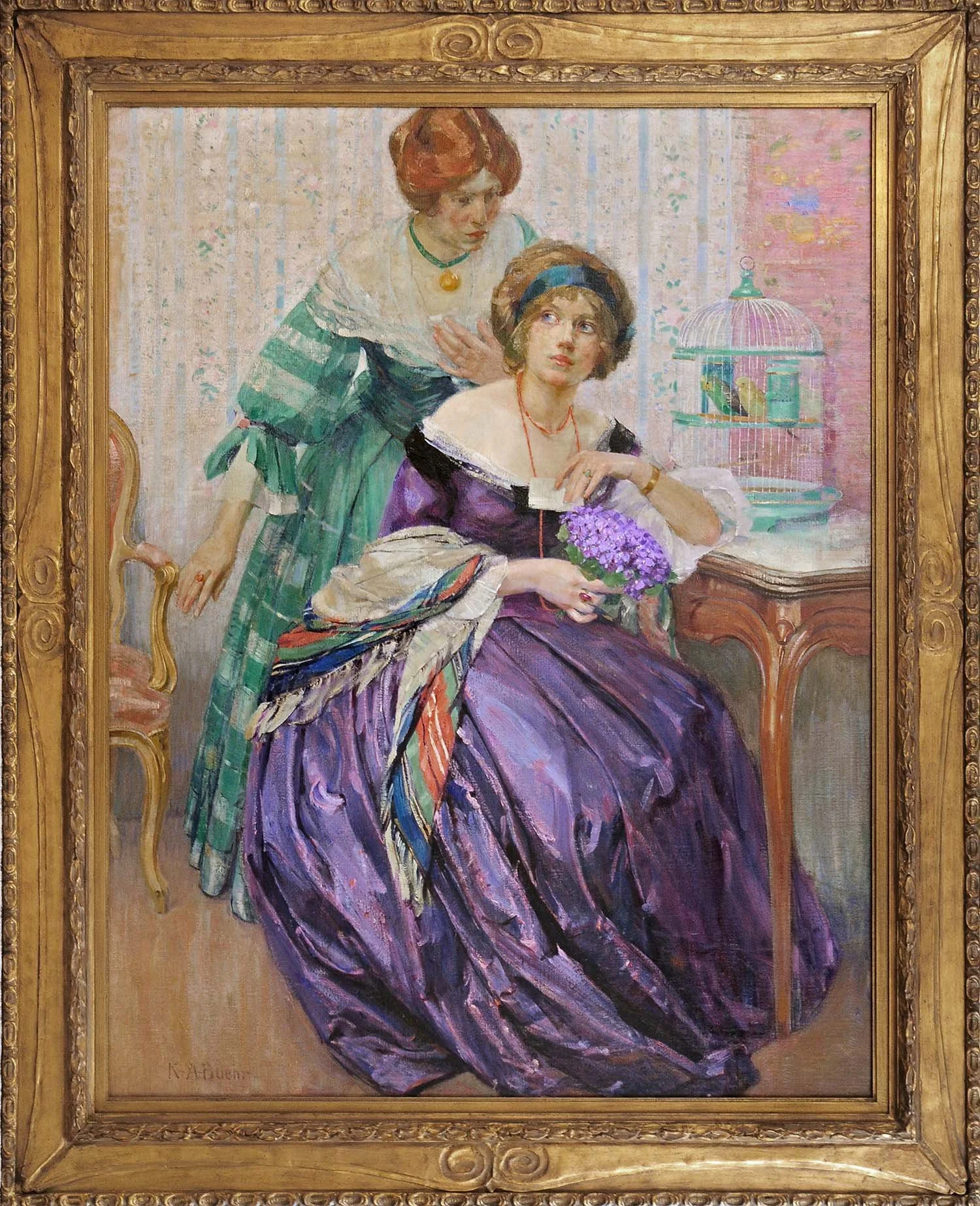
During the 1910s, critics in America and Europe often associated Buehr's work with that of the aforementioned Miller, noting their penchant for lavish hues, the fluency of their paint handling, and their three-dimensional treatment of the figure. Certainly, Miller acted as an important influence on Buehr, not only in terms of technique, but also in his practice of posing models in elegant nineteenth-century gowns—an approach Buehr embraces in Une Gage d'atnour (A Pledge of Love), a scene of feminine intrigue which features two rosy-cheeked women in a well-appointed bourgeois parlor decorated in a manner typical of the day. The figure wearing the purple dress has just received a bouquet of Parma violets that complements her luxurious costume, as well as a love letter that she attempts to conceal from her companion (possibly modeled by the red-haired Gaby, a favorite of many of the American figure painters in Giverny during the early 1910s).2 The scene is observed by a pair of parakeets confined to their surroundings in a cage; Buehr probably included them as a symbolic reference to their role as objects of beauty and to the conventional world of domesticity, which limited the freedom of women. Painters such as Frieseke also explored the "woman and a bird cage" motif, but, unlike Buehr, they showed little interest in capturing personality or emotion, or in conveying a story, preferring instead to concentrate on formal concerns relative to light and color. By contrast, there is a strong psychological component to Une Gage d'amour which heightens its appeal as a visual statement pertaining to the realm of womanhood.
By situating the figures in a shallow space close up on the picture plane, Buehr imbues the image with a sense of immediacy and heightens its emotional impact as our gaze moves from the secretive, yet thoughtful, young woman on the right to her concerned and obviously startled friend. As with typical of the Giverny aesthetic of the early 1900s, Buehr enhances the complexity of the painting by including an abundance of patterning, created by striped fabrics and wallpaper, by the cage, and by the curvilinear shapes of the furnishings.
Drawing upon his former academic training, Buehr adheres to a realistic and very convincing portrayal of the figures, capturing their individual beauty, as well as their distinctly opposing expressions. Conversely, the women's costumes and the surrounding decor are more broadly rendered, the artist's touch becoming especially light and ephemeral in his portrayal of the floor and wallpaper. An artist who was drawn to seductive colors, Buehr employs a palette dominated by the lush purple and deep green of the gowns, augmented here and there by accents of red, white, blue, and an array of luminous flesh tones.
One of the finest productions from his Giverny period, Une Gage d 'amour (A Pledge of Love) represents Karl Buehr at his best, revealing his ability to synthesize modem precepts of color and form with his love of representing the female figure. Not surprisingly, the artist exhibited this sumptuous canvas at the 1912 Paris Salon, where, as reported in the New York Times, it had been "much remarked [upon] for its richness of effect."3
—————
1 "Eleanor Jewett, U. of C. Offers Series of 12 Art Lectures," Chicago Tribune, 12 October 1952, clipping in Chicago Art Institute Scrapbook, 1952, p. 79.
2 Buehr used Gaby frequently during 1911-12. She is believed to be the model in his Picnic on the Grass (1911-12; private collection) and The Flower Girl (1912; Pfeil Collection).
3 "Fine Sculpture at This Year's Salon," New York Times, 1 May 1912, p. 6.
-
A prominent painter and teacher, Karl Buehr spent the majority of his career in Chicago. However, Buehr is also associated with the second generation of American painters to live and work in Giverny, France during the early twentieth century. Indeed, Buehr's Giverny experience played a vital role in his aesthetic development, inspiring his move away from a subdued, tonal approach to the decorative Impressionism he used in his depictions of young women in outdoor settings. According to one Chicago critic, Karl Buehr's name was synonymous with 'sunshine on a summer day; clear, lovely women who smile from a fresh canvas, and a quantity of flowers."'